womxn • history • sex • education • social justice

Tips for Introducing Bodily Autonomy, Consent, & Healthy Sexuality to Toddlers and Babies
I’m a firm believer that parents and families are our kids’ first and primary sexuality educators. Especially in this time when federal comprehensive sex education funding is getting slashed and there’s no guarantee your school-aged child in North Carolina will get any sex ed at all at school, family conversations about sexual health are more important than ever.
So how early can you start?
Earlier than you think!
Many parents think of the single, awkward “birds and the bees” talk when they consider talking to their child(ren) about sex. Perhaps that’s all you got when you were growing up! But research shows that scaffolding conversations about sexual health, starting at younger ages, can help prevent child sexual abuse and lead to healthier sexual relationships in the future. So think of the “sex talk” as actually many little talks that can begin as early as you want with developmentally appropriate information. Providing our babies and toddlers with some foundational knowledge about core concepts like consent, body literacy, and diversity can go a long way to make the actual preteen/teen sex talk way less awkward and way more effective.
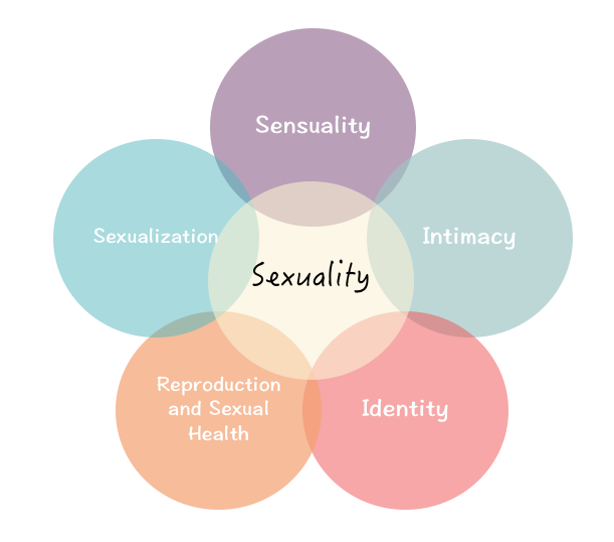
Sexuality actually includes a lot more than just intercourse! We can introduce many of these topics in an age-appropriate way when our children are babies and toddlers to set them up for healthy relationships with their bodies and their peers. Learn more about the model here.
As a mom of a newborn and 2.5 year old and a professional sexuality educator, here are some topics I’ve already brought up with my kiddos. Check them out to see if any resonate with you!
Naming Body Parts
I actually do this with my newborn! As soon as our babies are born, they have body parts–including sexual/reproductive body parts. As they are learning to move their bodies and form language, we can help them by using the anatomical words for all of their body parts. When they wiggle their hands, we can say, “Look at those amazing hands!” When we wipe their bottoms, we can say, “I’m wiping your vulva!” When we clean them in the bath, we can say, “Here are your penis and your scrotum!” When they stare at us with those huge baby eyes, we can say, “Look at those beautiful eyes!”
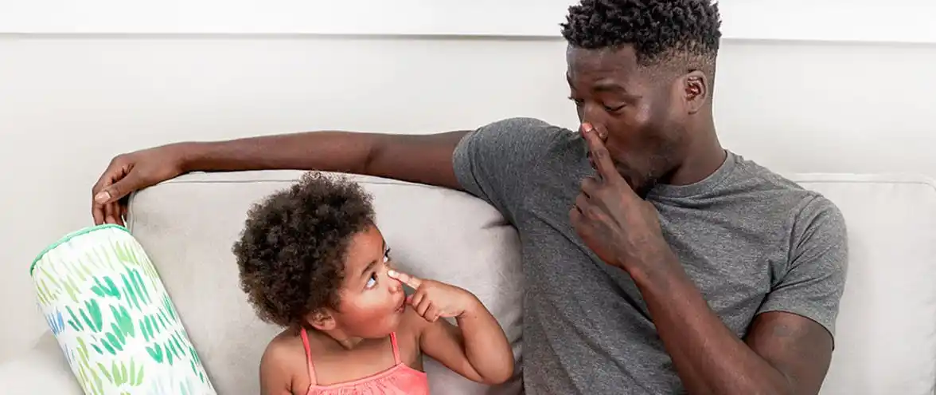
From Lovevery.
We don’t need to shy away from teaching terms for sexual/reproductive body parts; in fact, naming them alongside other body parts can help normalize them, reduce the likelihood of developing shame around them, and help prevent child sexual abuse. (Think about it: As soon as children can form words, they can use those words to tell a safe adult when someone is touching those body parts. If they say “Somebody touched my cookie at school,” you may miss a potential child abuse situation–”cookie” is a slang term for vulva in some families.)
It’s also really common for young babies and children to touch their own genitals. This is developmentally normal, and for me and my partner, it was something we didn’t want to discourage. We don’t want our kids to grow up with shame around touching their body, and as a sexuality educator, I knew that masturbation can actually promote body literacy and lend to more satisfying sexual lives later in life. So whenever our children touch their genitals at home, we either don’t say anything at all or say, in a very neutral tone, “oh, you’re touching your penis.” (See the section on “Public vs Private” below to continue this conversation!)
Consent Before Touching
I started this with my babies as well! You might be wondering, how do you ask consent from a preverbal baby? I introduced the concept early by telling my babies whenever I clean their chests or genitals that I am doing so. I will say, “Ok, I’m wiping your vulva now!” or “I’m cleaning your anus!” I don’t do it every single time I change a diaper–I’m thinking particularly about those times when I’ve got a screaming baby on the changing table, demanding to be fed–but I do it often enough that it’s now become a habit with my toddler’s diaper changes and baths.
When your kiddo starts being able to offer hugs and kisses, you can begin truly asking for and respecting their consent. You can offer choices: “Would you like to kiss Daddy goodnight or give him a high five?” or ask before touching: “Can I give you a hug?” This modeling can help teach the language and practice of consent to our under-2-year-olds.
Respect the “No”
Be warned: there will be a (heartbreaking) time when your little cutie will begin asserting her independence and say “No, Mommy!” to many of your bids for kisses and hugs. It’s important to RESPECT that. I found it really hard to move from kissing my cute little baby all the time to refraining from kissing my cute little toddler when he started being able to have a choice in the matter.
But we had language for this already. Whenever we tickle our toddler–or swing him around or give him big squishes to get the wiggles out–we stop immediately when he says “no” or “stop.” We say, “I respect your ‘no.’” Then we ask if he wants more or if he’s had enough.

From The Washington Post.
I’ve also offered the language, “It’s your body, so it’s your choice” and model it myself. When my toddler demands that I play with him on the floor but only sit in that specific spot (“No, mommy! Come here!”), I often will say, “I’m ok sitting right where I am. I get to choose what I do with my body.” This kind of language can support an early understanding of bodily autonomy.
Identifying Safe Adults
As soon as my toddler was verbal enough (around 2-ish I’d say), we started introducing the concept of grown-ups vs kids and then establishing safe grown-ups. So we’d ask him, “Who can you go to for help?” and he’d name “Daddy, Grandma, Mommy” (in that order because of course I’m chopped liver these days). We keep reinforcing that every so often, which can help for preventing and responding to situations of sexual abuse.
Public vs. Private
You can expand the safe adult conversation by introducing public vs private spaces. I just started introducing public vs private to my 2.5 year old, although we technically started even earlier; we have a “clothes have to be worn outside the house” rule that we had to start to get him to put clothes on ever. Already he has a sense that something is different about being inside the house vs outside the house in terms of how he presents his body.
During bath time one day around when he turned 2.5, I introduced a song about Private Parts that went viral on TikTok. This helped introduce the idea that some of his body parts are different than others; some of his body parts should only be shown and/or touched in private. After singing the song, we had a brief (as in 2-3 sentences) conversation about who can touch his private parts and when. It generally was along the lines of, “Mommy and Daddy touch your private parts in the shower/bath to keep them clean. [These safe grown-ups] touch your bottom to wipe your butt after you poop/pee. Your doctor touches your private parts at the doctor’s office to make sure they’re healthy. If you ever don’t feel comfortable, tell Mommy/Daddy/other safe adult.” I don’t think he understands that last part yet (about not feeling comfortable) but with reinforcement over the years, I think it will begin to make more sense.
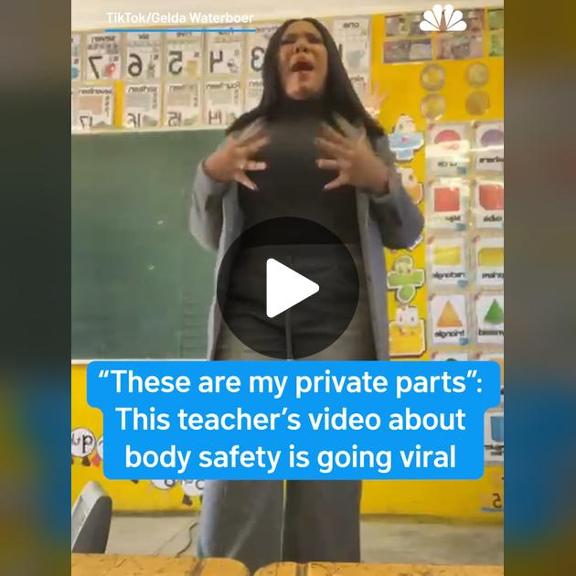
From tiktok.
Exploring Gender
This sexuality concept starts as early as finding out the sex of the baby–what clothes you’re going to buy, what toys you’ll offer, what pronouns you’ll use for your baby. We’ve opted for a “gender-lite” approach, in which we dress our kiddos in mostly gender neutral outfits and use more gender neutral words like “kid” instead of “girl/boy” while still following some gendered concepts like boy’s haircuts, for example. I believe strongly in allowing my children to explore gender, pursue things that interest them, and not shut down anything because “that’s only what girls wear.” This is a highly sensitive and personal topic, however, and I encourage you to do what feels best for your family! But I will say from a sexuality educator perspective, I have not found a need to introduce gender concepts like girl/boy/man/woman at this point. My toddler knows that some people have a penis and some people have a vulva but he doesn’t associate those with any gender at this point. I’d love for my kids to continue to explore and try things out at this age.
Exploring Diversity
I think it’s also really important to start discussing sexual diversity from a young age, with an emphasis on respect and the value of all humans. This helps prime conversations about gender, sexual orientation, and sexual diversity that we’ll have later on. I often recommend using books that showcase a wide variety of bodies and families to introduce the basic concepts that we’re all unique (our bodies and our families) and diversity is wonderful. Some of our favorite books have been Bodies are Cool by Tyler Feder, Families Can by Dan Saks, and Your Whole Body: From Your Head to Your Toes, and Everything in Between! By Lizzie DeYoung Charbonneau. I also like the Being YOU series but found them to be a little too advanced for now. I’ll probably wait til preschool/kindergarten (maybe later?) before really pulling out the vocabulary.
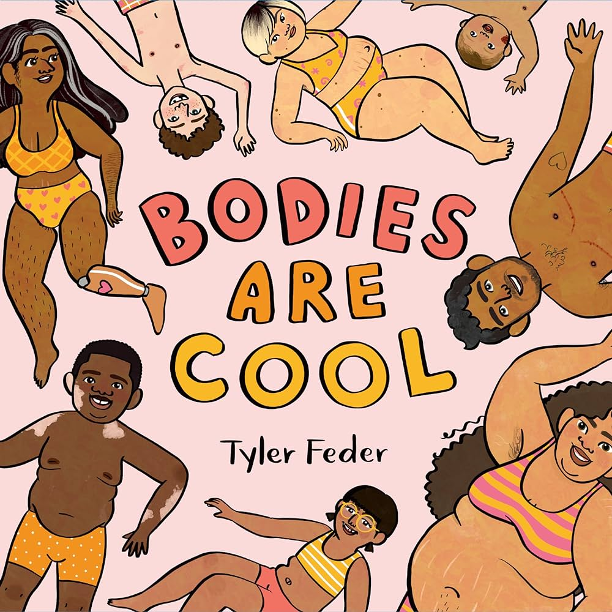
My favorite book that celebrates body diversity!
I hope this helps! For all things healthy sexuality, be sure to also check out my favorite resource, Sex Positive Families, which has a resource list full of books, games, and media you can curate by age, type, and topic.

Can you describe an ectopic pregnancy?--And why it matters
Here’s a little quiz! Is an ectopic pregnancy:
When a fertilized egg fails to implant in the uterus and exits the body as menstrual blood?
When a fertilized egg implants and begins to develop somewhere other than the uterus?
When a single fertilized egg divides in the uterus to produce twins?
Here’s a little quiz! Is an ectopic pregnancy:
When a fertilized egg fails to implant in the uterus and exits the body as menstrual blood?
When a fertilized egg implants and begins to develop somewhere other than the uterus?
When a single fertilized egg divides in the uterus to produce twins?
If you guessed “B”, congratulations! Option “A” actually describes a miscarriage or pregnancy loss. Option “C” doesn’t have an official term (as far as I know) but it is the single most asked sex ed question from my elementary school students who, for some reason, are obsessed with learning about twins.
As a sexuality educator, I often teach about ectopic pregnancies. It’s when an egg that’s already been fertilized (meaning it’s connected with a sperm and is traveling down the Fallopian tube) decides to stop its journey in the Fallopian tube–or in the ovary or stomach or cervix or other inappropriate place. Rather than correctly implanting in the side of the uterus, where it can safely develop into a fetus, the fertilized egg instead implants someplace else in the body and begins to develop there.

This happens in 1 out of 50 pregnancies in the U.S. and if untreated, is deathly or disabling to the pregnant person.
In fact, untreated ectopic pregnancies are a leading cause of maternal mortality in the first trimester. And in the US, our maternal mortality rate is shockingly and unjustly high for a developed nation.
Ok, another question for you all:
Myth or fact? Ectopic pregnancies can be safely implanted in the uterus to develop into a healthy pregnancy.
The answer is nope. Not at all. This is completely a myth, one that’s being touted by anti-abortion protesters with no medical research to back it up.
The only way to protect a pregnant person who has an ectopic pregnancy is to have an abortion.
In very rare cases, the ectopic pregnancy ends in miscarriage on its own; but in the vast majority of cases, medical intervention (i.e. an abortion) is required.
An abortion is a completely safe medical procedure that safely ends a pregnancy by expelling the contents of the uterus. It’s safer than actually having a baby. It’s even safer than driving a car! (Compare abortion death rates to car accident death rates; it’s 1 in 100,000 versus 1 in 107….)
As someone who wants to get pregnant one day, I read the U.S. news today and got really scared. Today a Supreme Court brief was leaked stating the court’s majority opinion that the historic Roe vs. Wade case be revoked. This would overturn Americans’ constitutional right to abortion and would allow individual states to create policies for their constituents around access to abortion.
22 states in the U.S. have “trigger laws”, or laws severely restricting or banning access to abortion that would go into effect the moment Roe vs. Wade is overturned. Many of these laws would even ban abortion if the pregnant person’s life was in danger.
In Missouri, a bill would make it illegal for pregnant people to abort ectopic pregnancies. In Texas, a bill makes it illegal for someone to perform an abortion or aid someone in getting an abortion (like driving them to the clinic), even if the pregnant person is experiencing an incomplete miscarriage, or an embryo that has stopped developing but hasn’t left the uterus. Leaving the non-viable embryo can cause non-stop bleeding and infection for the pregnant person. In Oklahoma, a bill would make it illegal for someone to perform an abortion or aid someone in getting an abortion even if they’ve been raped or have experienced incest.
And this doesn’t even begin to touch the reasons for safe, legal, legitimate abortion outside of protecting the health to the pregnant person.
What this all means for me is that if I lived in Missouri and developed an ectopic pregnancy during my own pregnancy journey, I would likely die from complications since I wouldn’t be able to access a legal, life-saving abortion. If I lived in Texas, had an incomplete miscarriage, and had bleeding that wouldn’t stop, I would likely die of an infection since I wouldn’t be able to access a legal, life-saving abortion. If I lived in Oklahoma and–God forbid–was raped during my pregnancy journey, I would only have the option of a dangerous, illegal abortion if I didn’t want to give birth to my rapist’s child.

Oh but Leslie, you say. You don’t live in any of those states. You live in North Carolina where abortion access is currently (albeit shakily) protected. Oh but Leslie, you make enough money that you could travel to another state where abortion is legal if you had a complication in your pregnancy. Oh but Leslie, you have had access to comprehensive sex education and affordable birth control so you wouldn’t get pregnant in the first place if you didn’t want to.
Sure, but it could be me. These situations could happen to any of the uterus-bearing folks in your life–to any of the 50% of Americans with uteruses. And if any of our national political bodies turn more red, abortion could be nationally banned and only international travel and lots of money would make abortion accessible to me and everyone else.
It is vital that we find the empathy within ourselves to imagine what it’s like to have a different experience from our own. What would you do if you were in a life or death pregnancy situation? How do you think many uterus-owning folks are feeling right now after hearing this news? How do you think it feels to hear the nation’s most powerful leaders say that your life doesn’t matter? What do you think a person with a different background and set of privileges and oppressions than you has to worry about and consider related to pregnancy, abortion, and reproductive choices?
This news is terrifying. And definitely hits too close to home for me. So I urge everyone: go out and vote (midterm elections are here!). Practice and embrace empathy. And tell everyone you know about how ectopic pregnancies really work because we all–at a bare minimum–deserve to know the medically accurate and comprehensive facts about our bodies. And we all deserve to be healthy and safe.

We Can't Forget
My partner and I lived in Rwanda awhile back, and there is one story that sticks in my mind above all others. A friend I got to know in Rwanda worked with an organization called Hope for Life, which provides housing and rehabilitation to children and youth living on the streets of Kigali, the capital of Rwanda. She told me the story of a 10- or 11-year-old boy who came to their center one day seeking help. He eventually shared with the center staff that he had been living on the streets for awhile with his younger brother after their parents had died. He and his brother struggled to find food and often had to steal food to get by. But there was a period of time when even stealing food wasn’t working, and every night the boys went to bed hungry. The boy at the center described the heartbreaking moment when he held his younger brother in his arms as he died from starvation. Traumatized, grieving, and starving himself, the boy eventually stumbled across the center, where he was given a place to stay and food.
My partner and I lived in Rwanda awhile back, and there is one story that sticks in my mind above all others. A friend I got to know in Rwanda worked with an organization called Hope for Life, which provides housing and rehabilitation to children and youth living on the streets of Kigali, the capital of Rwanda. She told me the story of a 10- or 11-year-old boy who came to their center one day seeking help. He eventually shared with the center staff that he had been living on the streets for awhile with his younger brother after their parents had died. He and his brother struggled to find food and often had to steal food to get by. But there was a period of time when even stealing food wasn’t working, and every night the boys went to bed hungry. The boy at the center described the heartbreaking moment when he held his younger brother in his arms as he died from starvation. Traumatized, grieving, and starving himself, the boy eventually stumbled across the center, where he was given a place to stay and food.
This image–of a boy holding his younger brother as the child died from starvation–will probably stick in my mind forever. To think that this was happening right in my neighborhood was heartbreaking. Dying from starvation was a reality so far from my own that it felt impossible that it was happening to this boy right in front of me, especially in such a modern, spotlessly clean city as Kigali. (If that image conflicts with your vision of an African city, you’re not alone–but do some research to learn about what African cities really look like today.)
I also will never forget the memory of taking our trash out at our apartment in Kigali. We lived in a relatively economically advantaged neighborhood, with our apartment building across the street from the large home of a former government official. Each week we would bag up our trash and plop it on the side of the street outside our gate. And each week, as soon as we emerged with trash bags in hand, a group of men and women wearing dirt-stained, tattered clothes would rush up and grab the bags. They were always so respectful of us, never snatching the bags directly from our hands but waiting until we set them down before jumping to be the first to grab the bags and take them away. We could then watch as they dragged the bags down the street, opened them up, and began sorting through what we had considered waste. They collected bottles, plastic containers, old clothes and shoes, even food scraps, sorting and organizing, seeing what they could use versus sell.
This memory is also burned into my mind, along with the image of that boy holding his dying brother. Now back in the U.S., it’s so easy to feel detached from these realities. I live in a nice house with my partner, and we have plenty to eat. Our worries include how the stock market is doing, which brand of Tofu to buy, and how to find time to go to the doctor’s. Of course, I don’t want to minimize the very real challenges of folks living in the US: mental illness and suicide rates, rising inflation, this horrible housing market, shitty policies that impact people’s ability to get healthcare (like the recent anti-abortion and anti-trans laws), structural racism and other oppressions that impact life expectancy…. But dying of starvation and fighting over trash seem so impossible when juxtaposed with my life.
I’m often reminded of that song in the opening credits of the TV show Weeds: “Little boxes on the hillside, little boxes made of ticky tacky.” Living a square life in little boxes made of ticky tacky is one of my biggest fears. I don’t want to be a typical housewife in a typical suburban house with a typical set of behaviors and attitudes. I don’t want to forget that poverty exists, that not everyone has the privileges that I do, that I should feel immensely grateful that all my basic needs are met.
Yet despite my fear of living this square life, I still fall into the trap of measuring my success against the stereotypical ladder of American (global?) success: go to college, get married, go to grad school, find a career, buy a house, and pop out some kids. I get so caught up in doing what society expects of me–and feeling shitty when my journey isn’t a simple, easy upward climb–and I forget that there are far greater problems in the world that should have my attention.
How do we not forget? How do we remember the injustices experienced by so many, both globally and right in our backyards, when we live in our isolated little boxes made of ticky tacky?
I believe that we have a choice to center these concerns–to find ways to remember. In fact, I think it’s our duty as privileged Americans who use up the largest percentages of the world’s resources to remember.
I’m definitely not perfect at remembering. But I try to think of that little boy and his brother when I’m eating my dinner. I try to not serve myself more food than I can eat, I try to finish everything on my plate, I try to use up everything in the fridge before it spoils. Whenever I throw something away, I think of those folks in Kigali and try to consider if I can reuse or recycle whatever it is I’m throwing away. We have to remember.
How do you remember?

The Importance of Letting Loose: How often do we just play?
It seems like the universe has been trying to tell me something recently. It just started coming at me from a ton of different directions all at once: hey girl, pay attention!!
And the message was about the importance of play.
It seems like the universe has been trying to tell me something recently. It just started coming at me from a ton of different directions all at once: hey girl, pay attention!!
And the message was about the importance of play.

As an adult, I don’t often think about my relationship to play. Maybe like the picture above, you think of messy children’s crafts and little kiddos running around laughing.
But just the other day, I found myself in a yoga class where the teacher was encouraging us to use Lion’s breath, which–for those who don’t know–is where you stick your tongue out and basically roar like a lion, and to roll around on the floor like a baby to “let it all out.” (Thanks to Kathryn Budig for that lovely class!) And it was seriously so freeing to be totally silly, even just for a moment.
And then I was reading a book about doulas and about the power of giving women permission to make noises, to be loud, to take up space. It was specifically about labor (because believe it or not, even in the most intense pain of giving birth, apparently women feel self-conscious about their body noises and try to hold their body’s natural reactions back), but just thinking about having that space to fully embrace our bodies and all their awkward/silly/embarrassing noises–and how powerful that can be for women who are so often told to stay quiet…. It really shook me.
And then! I finally made it to my monthly massage (do it y’all–best thing I’ve ever done for myself), and as I was relaxing into the sweet loveliness of having my body touched, I was thinking about my own journey with massage: how it’s moved from feeling totally anxiety-inducing as my brain goes crazy thinking about how I look, how my legs are hairy, how my thighs are too fleshy, and even sometimes if my masseuse is going to take advantage of me (trauma is rough y’all) to slowly becoming an experience where I can let go and just enjoy the sensations. It’s definitely an ongoing process–my anxiety still pops up sometimes--but I’ve loved how much massage gives me permission to feel bodily pleasure in exactly how my body is right now–even when my masseuse kneads my thighs like they’re giant balls of dough, which feels amazing and also cracks me up even just writing about it.
This wonderful bombardment of messages about play and pleasure got me thinking about how many of my most cherished memories revolved around me feeling absolutely comfortable giving myself into the absolute pleasure of being playful.
For example, one of the first get-togethers my current friend group had when we were just getting established (side note: making adult friends is HARD y’all!) was meeting up at one of our neighborhood playgrounds at night. We frolicked, laughed, clambered all over the place, and just played. We were silly and goofy and wholly ourselves–and despite this moment being so simple and so long ago, it’s still one of my most vivid memories.

How freakin cool does this look?! (Source: https://www.popsugar.com/family/Coolest-Playgrounds-United-States-41591182)
Another example: I’ve also gotten really involved in partner dancing in my adult years. I’ve done a lot of salsa and contra and now have fallen in love with zouk. (Please just go look at that video and let it rock your world.) My favorite, most memorable dances by far are the ones in which I have felt completely seen and able to be myself, when I’ve given myself–and received from my partner–the permission to be playful, to just go with the flow, to be messy and explore the possibilities.
Or, just think about the best sex you’ve ever had. I bet that play, permission to be yourself, and pleasure were all front and center. It’s so delicious when you can fully be yourself and can completely give into your body’s sensations with another person–even all the silly, awkward parts. It can feel mind-blowing and so healing. Why don’t we have that more often?
I think what makes play feel so good is how much it focuses on pleasure. In play, we are allowing ourselves to bring our full selves, to make mistakes and not be judged for them, to try out new things, and to really tune into what feels super super good.
As an adult, I think I get so caught up in my work–in needing to be professional at all times, in finding my worth solely in how much I produce–that play and pleasure are shut out. Lots of things in Western culture discourage us from playing and embracing pleasure: Capitalism tells us we must work and produce constantly to be worthy. Patriarchy tells women that we’re not deserving of pleasure and men that they can’t make mistakes. (Sexually assaulting someone is NOT a mistake though, just so we’re clear. For clarity, check out my previous post about restrictive gender norms.) White supremacy deems only certain types of bodies as beautiful and worthy. This means tapping into our bodies and finding chances to play and embrace pleasure can be really difficult.
For me, though, going on this journey towards self-acceptance through play and pleasure has been incredible for my mental health and overall well-being. And the universe is telling me to pay attention. It, too, tells me it’s worth it.

When was the last time you played? How do you find pleasure?
Struggling to tap into your body? Check out this article for some ideas.

“Let Me Try That:” What Ordering a Beer May Say About Your Sex Life–and How You Embrace Your Gender
I got the idea to write this post from a friend who bartends. Alex is the nicest man you’ll ever meet and has a face everyone thinks they recognize, although he mostly just looks like Jesus. He has been in the service industry for many years and has had a first hand look at how people communicate their needs and wants in some of the most well-traveled places: bars and coffee shops.
I got the idea to write this post from a friend who bartends. Alex is the nicest man you’ll ever meet and has a face everyone thinks they recognize, although he mostly just looks like Jesus. He has been in the service industry for many years and has had a first hand look at how people communicate their needs and wants in some of the most well-traveled places: bars and coffee shops.
When I asked about how his most recent bartending job has been going, Alex responded with both positivity (he loves his job!) and some frustrations. As a sexuality educator, my ears perked up when he started explaining some themes he’d noticed while working at the bar.
“A lot of people often say, ‘Let me try that’ in reference to a beer,” Alex said. “Some people mean, ‘Let me get a sample of that, let me taste that’ but other people mean ‘Give me a whole pint of beer.’ As the bartender, I have to try to figure out what they mean.”

This kind of indirect tiptoeing around what we really mean is really common in sexual situations. For example, when we ask somebody, “Hey, do you wanna hook up?” it can be really unclear what we mean by that. Do you mean have sex? Make out? Use our fingers? What are we talking about here?
Of course I wanted to learn more. I wondered if the gender of the person asking made any difference in their language or what they meant, so I asked Alex.
“Typically, when women say ‘I want to try that,’” Alex explained, “I know they want a sample. With men, I have to clarify by asking ‘Do you want a sample or do you just want to buy the beer?’ I’m never sure what they want.”
Alex added, “Men are sometimes a little surprised when I have to clarify. They thought they were communicating perfectly.”
He thought this might be because men are generally used to getting what they want in our society, especially white men. (He said that while he didn’t have a large sample size, he’d noticed that people of color regardless of gender asked for more samples than white men do. And that older white men tended to get overwhelmed by new options and ended up sticking with the same Pilsener that they know and love.)
We do live in a patriarchal society that structurally supports white people (do I even bother citing this?) so he might not be far off….
Alex said that in his experience, “Women are more likely to try different things and when they know what they want, they’re more direct--‘I want that.’ Women get what they feel like, and men get what they know, what they’re most comfortable with.”
While of course these are gross generalizations (and how do non-binary and intersex people ask for a beer??), research has shown that men often use language to assert dominance and women tend to be “more expressive, tentative, and polite in conversation” according to some scholars (Leaper, 1991; Maltz & Borker, 1982; Wood, 1996; Mason, 1994; Basow & Rubenfield, 2003 as cited in Merchant, 2012).
According to Alex, who also works at a local cafe, these gendered trends in communication styles and decision-making manifest beyond the bar and at the coffee shop as well.
“Big groups of businessmen are always coming into the coffee shop,” said Alex, “with their briefcases and suits, and asking each other, ‘What are you getting? What are you getting?’ Then they get whatever everybody else gets, which is usually a black coffee.”
He’s even seen guys get a black coffee and then pour out half of it to add sugar and milk, rather than order a sweetened latte or cappuccino.
I do kinda love the image of big businessmen looking frantically around at whatever everybody else is getting to know what they should order.

It seems to me that in a lot of ways, traditional gender roles are showing up in how we order beers and coffee. According to societal expectations, men are supposed to know and like beer, to be assertive and confident, to know what they want and get it quickly and easily. Men also hold more positions of power and therefore are perhaps more accustomed to having individuals know what they want and need. Real men definitely don’t drink frappuccinos.
Women, on the other hand, are supposed to be more passive, emotional, and indecisive. We’re not supposed to know that much about beer or even like it, but we are allowed to be frilly, so ordering an iced caramel macchiato with oat milk is on brand.
Even writing out these gender expectations, especially about women, makes me angry. Men and boys should be allowed to not know what they want and to explore different things to find what they like the best. Women should not have to feel ashamed and unconfident in their exploration of finding what tastes good. And what about all the people who don’t fit into these stereotypical norms?
In my line of work, I see these hurtful norms showing up in sex a ton, too.
Due to societal expectations, men and boys often show up to sexual relationships thinking they need to be super confident, assertive, and dominant, that they need to be the one to initiate all sexual activities, and that they should always know what they’re doing. They don’t often learn how to communicate empathetically with others and may get upset when they aren’t understood right away (which apparently happens pretty often at the bar when it’s super busy and guys don’t get their beer right away, says Alex).
Women and girls learn to be more receptive and not as confident in communicating what they want in bed and with intimate partners. However, at least according to our examples of the bar and coffee shop, women are more open to trying lots of different things.
These socialized preconceptions of gender--how we’re supposed to act, think, and communicate--are getting in the way of us having better experiences and communicating what we need and want clearly.
So how can we do better?
I love the idea of normalizing exploration and collaborative decision-making. We don’t often see this in our media, but our sex could be so much more fulfilling and pleasure-filled if we incorporate having a pre-sex conversation into our sexual interactions. Discuss what you both like, any fears or boundaries you have, your health status (have you both been tested for STIs recently? How are you planning to use contraception (or not)?), and things you want to try. Taking a page out of many bar-frequenting women, let’s normalize this exploration for men, too.
Respectfully. I can see Alex shaking his fist at me with this sudden increase in asking for samples at the bar.

Learning to communicate clearly, though, is also helpful in the bedroom–and the bar–and helps reduce frustration and anxiety. If you are typically an indecisive–or even people-pleasing–person, work towards developing confidence in yourself and your needs. Practice asking for what you want in everyday situations and not questioning your need for it. As a people-pleaser myself, I’ve found it helpful to surround myself with self-care reminders that say things like, “You are worthy,” “You are powerful,” “You’ve got this.” (It sounds silly, but it works!) Write down what you want to say, or practice difficult conversations with a friend, especially if having conversations about sex make you nervous. Get comfortable with sexual terminology. You could even share with your partner that you often get nervous expressing your needs and have them support you in asking you questions or probing for your response.
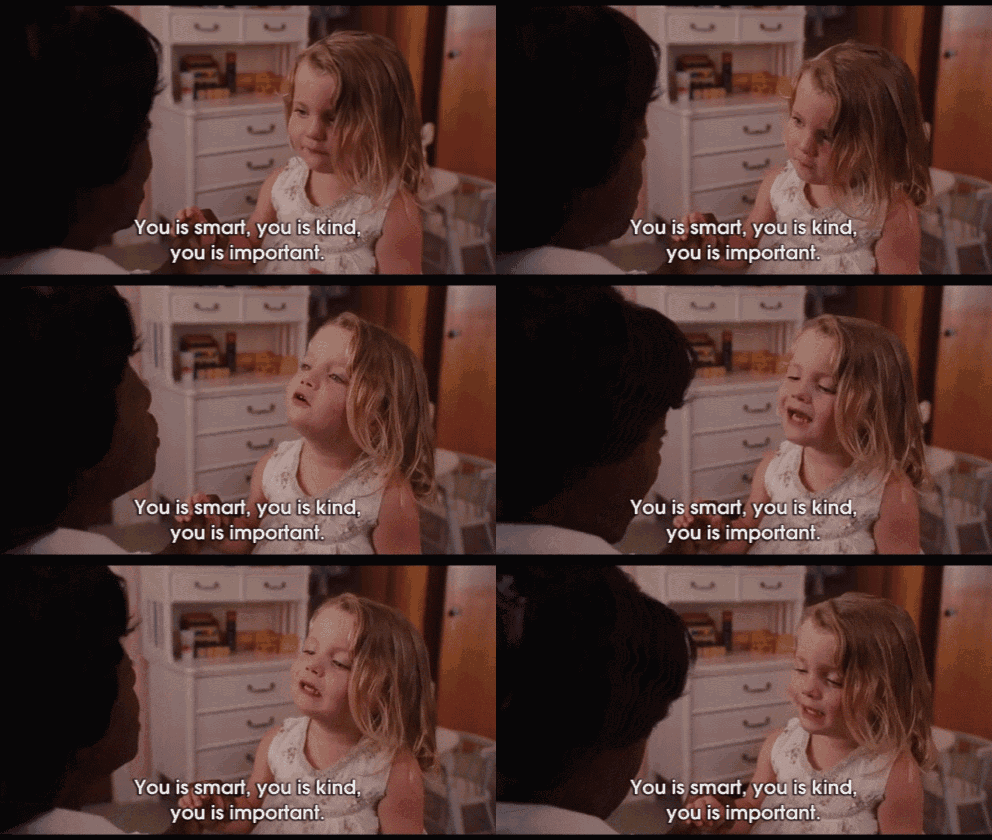
If you don’t feel nervous asking for and getting what you want in the bedroom, consider ways you could better tune into your partner(s). What cues can you notice in their body language and verbal responses? Are they into this? Do they seem hesitant? How can you better clarify or communicate with them? Work on challenging your frustration when you’re not understood (mindfulness and meditation practices are great for this!). Even at the bar, consider how your bartender looks and feels. Are they frazzled? Super busy?
And lastly, how can we develop confidence in acting in ways that feel right to us, that may or may not fall into societal gender expectations? A friend of mine once led an exercise on gender joy and helped me realize just how many ways we already defy gender roles and expectations. For example, I use men’s deodorant on the reg (it’s sooo much better than women’s versions!) and use Irish Spring soap instead of Dove. I’m defying gender expectations just in my hygiene routine. How can we continue developing confidence in these choices we already make to do what works best for us and spread that confidence into other areas of our lives?
So that’s my take. How would Alex like us to order a coffee or a beer?
“Just take a couple seconds to look at the menu, decide what you want, then confidently say it.”
“Oh,” he added. “And be respectful of those around you.” So getting that venti nonfat organic chocolate brownie frappuccino with oat milk extra whip double blended with two shots of caramel syrup when there’s a huge line behind you is maybe not the best move.
References:
https://scholarship.claremont.edu/cgi/viewcontent.cgi?article=1521&context=cmc_theses).

“Hey Guys!” Why we say it and why it’d be nice if we didn’t
“Hey guys! Wanna grab some pizza?”
“You’re doing great, guys!”
“I love you guys!”
The amount of times we use “guys” on the daily to refer to a group we’re with is pretty much innumerable. We use the term “guys” for all types of groups: groups of males only, groups with mixed genders, groups of all women…. And we use it everywhere: in our speech, our writing, our media.
Seriously, look back through your texts or pay attention when you talk to your friend group next time you venture outside your homes. How many times do you or someone else use the word “guys”?

Despite using this term so freaking much myself, I’ve started cringing whenever I hear the word “guys” now. (The amount of cringing happening on the daily might be why I have to see a masseuse so often these days….)
While it may seem like not that big a deal, the pervasive use of “guys” to describe any mixed gender or non-male group denies the existence of women, non-binary friends, and gender fluid folks.
That’s a little harsh, you might say.
That’s not my intention!, you may say.
Hear me out. When we use the word “guys” to describe all groups of gender diverse humans, we make “guys” or “maleness” the norm. It’s a quiet assumption, probably not intentional, but it’s a subtle way that maleness becomes normalized as the given, as the generic or “go to.”
Well, it’s not hurting anyone, right? So why does it matter?
This language is subtle but it’s part of a larger system that privileges men and boys. Maybe using the word “guys” all the time wouldn’t be so bad if we lived in a world where women were treated equally in the workplace; where people didn’t tell trans folks that they don’t exist, that they’re “just pretending;” or where males didn’t dominate most leadership positions in our country.
The ways that women move through the world are often not honored, recognized, and valued in the same way that men’s ways of being are. Just take a look at the gender pay gap or how women aren’t able to speak up in meetings. It’s even worse for non-binary and trans folks: consider how we only have two gender options to tick on most forms or the amount of bullying, suicide, and murders against trans and non-binary individuals.
Gender norms are all wrapped up in this emphasis on maleness. We have so many rules about how men and women are supposed to be, look, and act–and this has real impact too.
According to the CDC, adhering to traditional gender norms is a major risk factor for perpetration of sexual violence.
Thinking that men need to be aggressive, confident, loud, and dominant leaders and that women need to be silent, withdrawn receptacles is a main cause of 1 in 6 American women being a victim of rape or attempted rape in their lifetime and almost 1 in 2 transgender folks being sexually assaulted at some point in their lifetime. We’re just not respected or given the same power and space as men.
As a sexuality educator and consultant, I do a lot of work with young people on breaking down the gender binary and examining harmful norms. We do activities that examine how restrictive gender norms that dictate how women and men are “supposed” to behave can cause oppression for some and stress and unhappiness for others. All of us end up feeling pressure to behave a certain way and are afraid of being bullied or ostracized if we don’t conform.
I’m always amazed by how far ahead our youth are, even than us Millennials. More and more when I do these activities, especially ones that introduce gender identity models like the Gender Unicorn or the Genderbread Person, my students tell me, “Leslie, we’re just so over gender.” They talk about a post-gender society, about not strongly identifying with gender at all, about not understanding what all the hype is about.

I couldn’t even convince them with this model from the Trevor Project where you place single or multiple dots based on how you identify your gender.
“People should just be who they want–the labels don’t matter,” they tell me.
Taking a page out of their book, young folks and LGBTQ+ communities both have great examples of alternative language we can use that de-emphasizes gender and subsequently, decenters maleness.
Next time you’re tempted to say, “hey guys!”, consider trying out “Hey friends or folks or y’all!” instead.
Want to make your language more gender neutral in general? Check out this guide.
And with that, thanks for reading guy–I mean, folks!

I’m Disabled: Coming In and Coming Out
When I hear the word “disabled,” my mind immediately conjures folks in wheelchairs, individuals with conditions like cerebral palsy or autism, and older folks with mobility limitations—in other words, only extremes. (Just to be clear, these are all disabilities, and these folks are wonderful and beautiful.)
When I hear the word “disabled,” my mind immediately conjures folks in wheelchairs, individuals with conditions like cerebral palsy or autism, and older folks with mobility limitations—in other words, only extremes. (Just to be clear, these are all disabilities, and these folks are wonderful and beautiful.)
And I don’t think I’m alone in picturing these extremes. Our society has stereotyped folks with disabilities for a long time, and these stereotypes are pervasive in our media, our interactions, and our mindsets.

Just the other day, I went to a movie-in-the-park series that started off with The Goonies, a childhood fav. One character, named “Sloth” is the quintessential disabled character in media. Played by a nondisabled actor who apparently underwent five hours of make-up to become his character (according to Wikipedia), “Sloth” is portrayed as slow (if the name is any indication), unintelligent, and childlike. These are the images of disabled folks that I and many others grew up with.
Even in really common, everyday language we see hints of these stereotypes. We use words like “crazy,” “dumb,” “insane,” and “stupid” literally fifty times a day and never stop to think about the historic uses and current impact of these words on people with disabilities. The pervasive use of these words continues to perpetuate stereotypes about disabled people that are super messed up. (Thanks to my friend and disability activist Jaxson Benjamin for this learning!)


Photo sources: https://wiki.ubc.ca/Ableism; https://en.wikipedia.org/wiki/Ableism
My own process of coming into my disabilities has been lifelong. I’ve had asthma since childhood but never really considered it a disability, despite my reliance on daily medication and a rescue inhaler to exercise. Having asthma never prevented me from being an athlete and pursuing all the physical activities that are a key part of my life. It just meant it was a little harder without the aid of medication.
I only recently realized that my struggles with mental illness are categorized as a disability. This also doesn’t fit my image of disability, but it does make a bit of sense. It’s taken me some time, but I now understand that mental illness truly is a disease*, and when I’m really bad, I don’t leave bed all day, just like when I’m sick. Does my mental illness impact my ability to do everyday tasks? Yes. Do I rely on aids to help me go about my day? Yep. (Thank goodness for therapy and meds.) Is this a disability? I guess it is.
But this summer, I made my first foray into a visible disability when I got hearing aids. I first need to share with the world that I LOVE my hearing aids. My audiologist told me that I was working twice as hard to hear speech, and having this aid amplify sound has been a game changer. All the cool high school kids are saying that it’s pretty great to listen to my music or podcast without anybody else noticing (because the sound goes directly to my hearing aids, no headphones needed), and they’re not wrong. I did worry that people would treat me differently if they saw me--a healthy looking, 30-year-old--wearing hearing aids. But I vowed to myself to be open and proud about them because they’re super great. I’m the same me, just visibly disabled.
My first visible disability made me ponder why I now was okay accepting the label “disabled” when before I wasn’t. With my invisible disabilities, I could pass as non-disabled, and until now, I have been able to hide all the aids, supports, and workarounds that have become a part of my life. But now with hearing aids, I can’t hide. It’s caused a coming out of sorts, one that I am proud of and is becoming a part of me.
About 10% of the U.S. population has an invisible disability. I think we need to really reconsider how we define disability and the impact that has on folks. Why did I feel the need to hide my disabilities for so long? How has that process been intertwined with shame? What would it look like to view disability on a spectrum that encompasses a wide range of conditions? What would it look like to live in a world created for disabled people?
I don’t want to fill this article with statistics about the stigma and oppression related to disability but it’s there and it sucks. I think some of this stigma may lessen the more we begin to see disability as a spectrum. So I encourage all of us to think about:
- Do I rely on certain aids, supports, or workarounds to go about my daily life?
- Are there certain times when I’m unable to go through the motions of daily life? Why?
- Do I use ableist language in my daily life and what impact does that have on society at large?
- Do I have hidden parts of myself that I’m afraid to share with the world? Why?
- What would it take to make me feel confident in sharing my most authentic self with the world?
All I know is that, contrary to so many stereotypes, THIS is what disability looks like. And this is only one of the MANY representations of disability in our society.


Photo cred: Elise Massicotte
I feel the urge the end with some positive disability hashtags so pardon me while I dive into this research myself and share some of the good ones out there with you…. Check them out: #DisabilityJustice #InvisibleIllness #Inclusion #DisabilityPride #DisabledAndCute
*This word comes with a lot of connotations. Mentally ill people aren’t “diseased” like “ew, gross, bad” diseased; I just mean that our mental illnesses should be treated just as seriously as physical diseases would be.

Porn: What am I seeing??
I’ve been writing posts for our youth empowerment blog with my job at the Compass Center. I wanted to share them here as well. Porn is pretty accessible today for young people and adults alike. However, porn has been made for entertainment, not for education. Check out this post for tips on understanding the dynamics within porn.

A Brief History of HIV
I’ve been writing posts for our youth empowerment blog with my job at the Compass Center. I wanted to share them here as well. In our sex ed classrooms, we often learn a lot of about HIV prevention but not a lot about the history of HIV and how we get to where we are today. Check out this post to learn more about the start of HIV in the US.

12 Common Teen Questions about Sex & Sexuality
I’ve been writing posts for our youth empowerment blog with my job at the Compass Center. I wanted to share them here as well.
Ever wonder what sexuality issues are on the top of youths’ minds today? Check out these 12 common questions from teens and maybe learn something yourself!

Reframing Sexuality: It’s More Than the Birds and the Bees
I’ve been writing posts for our youth empowerment blog with my job at the Compass Center. I wanted to share them here as well. This post explores an awesome holistic model of sexuality. Sex is not just about, well, sex! It’s also about identity, intimacy, sensuality, and power.

Trans Sex Ed: What You Need to Know
I’ve been writing posts for our youth empowerment blog with my job at the Compass Center. I wanted to share them here as well. In this post, I explore trans sex education, which sadly is too often omitted from sex education spaces. Get some tips about sexual health considerations for trans folks.

Asthma, Yeast Infections, & STIs: Let’s think about Sexually Transmitted Infections in a new way
I’ve been writing posts for our youth empowerment blog with my job at the Compass Center. I wanted to share them here as well. In this post, I explore just how prevalent STIs are and how we need to totally rework how we think about STIs to effectively treat and prevent them.

Vulva vs. Vagina: What the Research Says You Need to Know
In the US, talking about our sexual anatomy is pretty darn taboo. We teach our kids to use words like “cookie”, “ding-a-ling”, and “private parts” and tend to avoid providing our kids with the specific terms like vulva, penis, and genitals.

Viva La Vulva II by Silvia de Bejar
In the US, talking about our sexual anatomy is pretty darn taboo. We teach our kids to use words like “cookie”, “ding-a-ling”, and “private parts” and tend to avoid providing our kids with the specific terms like vulva, penis, and genitals.
Our sex education is also sorely lacking, with only 17 states required to provide medically accurate information about sex and anatomy (1). Additionally, studies have found that educational textbooks fail to cover the clitoris and vulva as much as the penis or only focus on internal anatomy like the uterus, ovaries, and vaginal canal (2).
Folks think it’s inappropriate to show accurate pictures of the vulva and penis to, well, anyone--but especially kids. I wish I could count the number of times I was told as a sexuality educator that the drawing I use to show external anatomy of the vulva, clitoris, and vaginal opening was “too graphic.”
(First image: what I wish I could show students, from the Our Whole Lives curriculum. Second image: what I sometimes end up being allowed to show students.)


So it’s no surprise that as adults, we lack basic vocabulary and understanding of our sexy parts, specifically female* ones.
There’s research to prove this. A study from 2013 found that 80% of male college students and 62% of female college students were unable to locate the vagina correctly (3). 62% of female college kids can’t find the vagina?! Where do they think their period blood has been coming from?!
Another interesting study suggested that many women do not know what exactly the vulva describes and what is considered “normal” genital anatomy because they have not been exposed to a diverse range of normal genitalia (4). This is a huge issue when we’re trying to figure out what ours look like and if we should be embarrassed about them or not. (Hint: you should NEVER feel embarrassed about your sexy parts! Variety is normal!)
And there is some indication in a number of other studies that race and class may impact our knowledge of sexual anatomy, with low income individuals of color scoring lower on sexual anatomy knowledge and understanding than white individuals (5). Which is just extra bad (i.e. scary, infuriating, racist, classist, oppressive…) because everyone deserves to be represented and to know that their bodies (and their sexy parts!) are great.
So on the whole, the research points to a general lack of understanding of specifically female* genital anatomy and a confusion about what’s normal.
So let’s clear it up a bit.
One particular wisdom nugget that has been lacking in our public understanding is the difference between the vulva and the vagina.
What’s a vulva, you ask?
The word “vulva” isn’t often included in our anatomy lessons even though it’s pretty much THE term to describe the private parts of about half of the world’s population.
The vulva describes the area containing the labia, clitoris, vaginal opening, and urethra. The vagina is the canal that is mostly on the inside of the body and that connects the vaginal opening to the uterus. The vaginal opening is the only part of the vagina we see from the outside.

The vulva is the whole bit, the vagina is the internal canal leading to the uterus. We can only see the vaginal opening from the outside. (Source: Lady Suite)
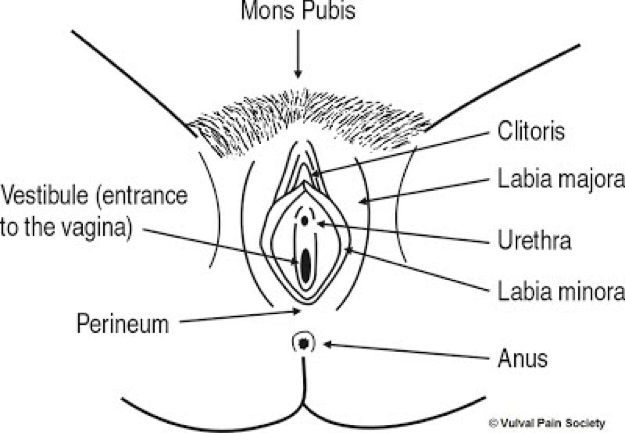
To brush up on your general sexual anatomy knowledge, check out this great resource page from Planned Parenthood: https://www.plannedparenthood.org/learn/health-and-wellness/sexual-and-reproductive-anatomy/what-are-parts-female-sexual-anatomy (Source: Vulval Pain Society)
The TV show Big Mouth does a great job explaining the difference and walking you through the different parts of the vulva, with a cute vulva friend as your guide:

The other aspect that is sorely lacking is diversity of vulvas. Because of anatomy textbooks and porn, we imagine all vulvas are white and smooth, with pink lips, no hair, and tiny labia. Not true! Vulvas come in so many shapes, sizes, and colors and it’s a sad thing that we don’t get to see that variety until we’re actually having sexy time with others. It causes folks to think their vulvas are abnormal, smelly, embarrassing… when in reality, they are totally great just how they are!
So I leave you with a great big variety of truly lovely vulvas.
And if you haven’t already, go ahead, take a mirror, and do a little exploring yourself. Or treat your vulva-owning partner to a little tour, with their consent of course.


Image 1: #VULVALUTION by Cult Beauty
Image 2: The Vulva Gallery by Hilde Atalanta
Image 3: Vula art by Vielma.at
Image 4: Vulva art by Vielma.at
Image 5: The Great Wall of Vagina (although it should be called ‘The Great Wall of Vulvas’....) by artist Jamie McCartney
Image 6: By Erin Tobey
End Notes:
*female: I use the term “female” because the research uses this term to describe folks with vulvas, uteruses, and ovaries. However, some folks with vulvas don’t identify as women, and some women don’t have vulvas.
References:
Guttmacher Institute. (2020, October 12). Sex and HIV education. Guttmacher Institute. https://www.guttmacher.org/state-policy/explore/sex-and-hiv-education
O’Connell, H. E., Sanjeevan, K. V., & Hutson, J. M. (2005). Anatomy of the clitoris. The Journal of Urology, 174, 1189 –1195; Ogletree, S. M., & Ginsburg, H. J. (2000). Kept under the hood: Neglect of the clitoris in common vernacular. Sex Roles, 43(11/12), 917-926; Orenstein, 2015, cited in Hesse, C. & Pedersen, C. L. (2017). Porn sex versus real sex: How sexually explicit material shapes our understanding of sexual anatomy, physiology, and behaviour. Sexuality & Culture, 21, 754–775.
Volck, W., Ventress, Z. A., Herbenick, D., Adams Hillard, P. J., & Huppert, J. S. (2013). Gynecologic knowledge is low in college men and women. Journal of Pediatric & Adolescent Gynecology, 26(3), 161-166.
Howarth, C., Hayes, J., Simonisa, M., & Temple-Smith, M. (2016). ‘Everything’s neatly tucked away’: Young women’s views on desirable vulval anatomy. Culture, Health & Sexuality, 18(12), 1363–1378.
Angulo-Olaiz, F., Goldfarb, E. S., & Constantine, N. A. (2014). Sexuality information needs of Latino and African American ninth graders: A content analysis of anonymous questions. American Journal of Sexuality Education, 9, 21-40; Cooper, S. C., & Koch, P. B. (2007). “Nobody told me nothin”: Communication about menstruation among low-income African-American women. Women & Health, 46, 57– 78; O’Sullivan, L. F., Meyer-Bahlburg, H. F. L., & Watkins, B. X. (2001). Mother-daughter communication about sex among urban African American and Latino families. Journal of Adolescent Research, 16(3), 269-292; White, L. R. (2013). The function of ethnicity, income level, and menstrual taboos in postmenarcheal adolescents’ understanding of menarche and menstruation. Sex Roles, 68(1–2), 65–76.

The Science of Blue Balls
The topic of blue balls has recently come up for me in conversations—you know, as just a thing young adults talk about. What is it? Does it actually exist? What does the medical world say about it? Is it “real”? As a sex educator, of course I wanted to dig deeper and find out more.
The topic of blue balls has recently come up for me in conversations—you know, as just a thing young adults talk about. What is it? Does it actually exist? What does the medical world say about it? Is it “real”? As a sex educator, of course I wanted to dig deeper and find out more.
For those who aren’t familiar with the term, “blue balls” refers to the phenomenon in which a person’s testicles allegedly turn blue because of unreleased pressure during sexual arousal. Basically, during arousal, blood flows to the penis to allow it to become hard, or erect, and sperm readies itself to exit the penis through ejaculation. The idea is that when the sperm are not released through ejaculation, it creates an aching, painful sensation or pressure that has been termed “blue balls.” In other words, it’s the pain and discomfort caused from not getting off.
Before I dove into medical research on the subject, I wanted to explore the language we use to describe blue balls. I googled “blue balls” and perused the top hits.
From an article on dudeproducts.com, we get language such as this:
“But seriously, blue balls is totally a thing—and it can be agonizing. So, what exactly is this scrotal suffering? How does it happen? Is there hope for the afflicted?”
An article on askmen.com adds:
“The more easily you're aroused, the more likely you'll suffer the wrath of blue balls.”
A Men’s Health article states, “For centuries, men have bemoaned the scourge of blue balls.”
Urban dictionary describes blue balls as “a ridiculously painful condition” and one user wrote, “It felt so brutal. I held my balls in pain but it was like they were replaced by sad blue bags of disappointment.”
“Sad blue bags of disappointment”?? For real?
What does this language suggest?
It paints the condition of blue balls to be one of agonizing pain and suffering. It insinuates that this suffering should be avoided at all costs—why would anyone want to feel that amount of pain and discomfort? It touches on the “disappointment” men feel when they’re not given the orgasm they expect. It calls upon the traditional gender norms that women should please their men and that men should not have to suffer any denial of sexual pleasure.
Indeed, it was presumed by myself and my female peers growing up that blue balls was a condition to be avoided at all costs and one that women were expected to prevent and alleviate during sexual interactions. The blue balls excuse was used both externally by male partners pressuring women to finish them off and internally by women feeling they needed to follow sexual acts to completion for their male partners in order to avoid hurting them.
The excuse of blue balls has been used to perpetuate the patriarchal “norms” that privilege male pleasure and sexual experience over anyone else’s.
But are blue balls real? Or has the condition been made up and/or exaggerated to support the patriarchy?
I turned to medical literature.
I did some basic google searches and found that blue balls has also been called epididymal hypertension or vasocongestion, or I even found it being called DBS, or deadly sperm buildup. So, besides the last one, these terms made it seem like it could be a “legit” medical condition.
Yet, even using those search terms, I found little to no information in the (albeit limited) medical journals I have access to on the concept of blue balls. I even reached out to my mother, a family physician, and my graduate school professor, a pediatrician who teaches our Reproductive Biology class, and they couldn’t find any additional literature either.
My searches only came up with one article in Pediatrics and two associated Letters to the Editor commenting on that article.
The original article, published in Pediatrics in 2000, detailed a 14-year-old male who showed up at the ER with 1.5 hours of prolonged scrotal pain. After an hour of observation, the pain receded and he left the ER. The article detailed that “Telephone follow-up several weeks later revealed that the patient had begun to have sexual intercourse with his girlfriend, and no further episodes of testiculoscrotal pain had occurred.”
Of course, I couldn’t help but wonder if the patient used his pain as an excuse to get his girlfriend to have sex with him…. But, who knows.
The rest of the one-page article described the complete lack of any reference to blue balls in medical literature as of 2000 and physicians’ lack of medical understanding of the phenomenon. It then went on to suggest that the treatment was sexual release or perhaps lifting something heavy like a car bumper. (LOL—what??)
The letters to the editor, also from 2000, disputed the treatment option of lifting car bumpers as the first choice when masturbation is such a clear solution (thank you). Yet, another letter expressed concern of unilaterally advocating for such a controversial solution like masturbation, claiming the adverse effect of blindness. (The only source of this was “personal communication” from “our mothers” so….)
When I reached out to my professor regarding this lack of literature, he reminded me of the danger of using only the medical establishment to confirm or reject possible real-life experiences. I had definitely heard stories from male friends of their very real experiences of blue ball pain—why would they make that up?
I was reminded of the history of the medical field—doctors and researchers alike—discounting the very real pain of black folks in particular: for example, the incredibly painful experiments without anesthesia on female slaves by the doctor heralded as the man who devised effective treatment for vesicovaginal fistulas. Or the experiments conducted on black prisoners by the world-famous dermatologist that left them with painful sores and lifelong medical complications. I’ve heard stories even today of black women being denied pain relief when they turn to medical professionals for help. There is a history of Western medicine discounting folks’ pain that deserves attention.
And also, I think about how the experience of blue balls has been used by privileged men, not just wealthy, white men but by men generally who inherently have privilege through their gender, to coerce and force women (probably womyn* too, I’m just less familiar) into having various forms of sex against their will.
Regardless of the discomfort in someone’s genitals, no one should ever feel they need to have sex to relieve someone’s pain.
So, here’s what I can leave you with:
1) No medical research can confirm that the testicles actually turn blue from a lack of sexual release—that piece might be a myth. If they are turning blue, it could be indicative of a more serious problem, like testicular torsion, that requires immediate medical attention.
2) It was also pretty clear in my search that the condition is not a dangerous one. There is no risk of rupture, permanent damage, or death (of sperm or patient).
3) Masturbation is great. Jerk off, yank one out, beat the bishop…. Masturbation is a safe, risk free way to embrace pleasure and release sexual tension (regardless of anatomy!). It will not make you blind or cause your hands to get hairy, despite what those doctors’ moms say.
4) Folks with vulvas get sexually frustrated, too! I kept thinking in my research, why aren’t blue vulvas being talked about?? How many times have I had to suffer the “excruciating pain” of my male partner getting off while leaving me with not even an inkling of attention for my lady parts? Male pleasure is expected and prioritized; female pleasure is ignored and devalued.
5) And the key message I hope you all leave with: no one should ever feel coerced, pressured, or forced to have any kind of sex they don’t want. Blue balls, or literally anything else, should not be a reason to finish someone off. Everyone is responsible for their own pleasure—as Men’s Health says, “go be a man” [or a woman, or a person!] “…and take care of yourself.”
*womyn: Many folks identify as women but don’t have vulvas or uteruses. The spelling of women as “womyn” accounts for the fact that womynhood can be defined in so many ways and all are great.

Feel Alone? Have a Sensitive Question? Check out the Real Talk App, a Safe Space for Teen Stories
I’ve been writing posts for our youth empowerment blog with my job at the Compass Center. I wanted to share them here as well. In this post, I interviewed the cofounder of the Real Talk app, an app for teens to share stories about puberty, relationships, and bullying.

I’ve Got a Penis But I’m Not a Boy…. Sex and Gender Explained
I’ve been writing posts for our youth empowerment blog with my job at the Compass Center. I wanted to share them here as well. This post explores the difference between sex and gender—super important for understanding our transgender friends and how many folks are fluidly defining their identities.
I’ve been writing posts for our youth empowerment blog with my job at the Compass Center. I wanted to share them here as well. This post explores the difference between sex and gender—super important for understanding our transgender friends and how many folks are fluidly defining their identities.

How racism is a sex ed issue
I’ve been writing posts for our youth empowerment blog with my job at the Compass Center. I wanted to share them here as well. This post explores how sex ed has racist roots and what local youth in North Carolina have to say about it.

Four Healthy Relationship Tips from Non-monogamists
This summer, as part of my Master’s of Education in Human Sexuality, I’m taking a grad school class on non-monogamy, and it got me thinking about healthy relationships. I teach about healthy relationships to young people all the time and never thought about the really important lessons that non-monogamy can offer about open communication, love, feelings, and trust. In this post, I want to explore non-monogamy a bit with you and share some lessons that can be helpful for all of us who strive for healthy, happy relationships.
This summer, as part of my Master’s of Education in Human Sexuality, I’m taking a grad school class on non-monogamy, and it got me thinking about healthy relationships.
I teach about healthy relationships to young people all the time and never thought about the really important lessons that non-monogamy can offer about open communication, love, feelings, and trust.
In this post, I want to explore non-monogamy a bit with you and share some lessons that can be helpful for all of us who strive for healthy, happy relationships.
You might have a lot of stereotypes against folks who don’t commit to monogamy. I get it. Our culture firmly situates monogamy as the only right way to have a romantic or sexual relationship. I ask that you read this post with an open mind.
Let’s start with a definition.
What exactly is non-monogamy?
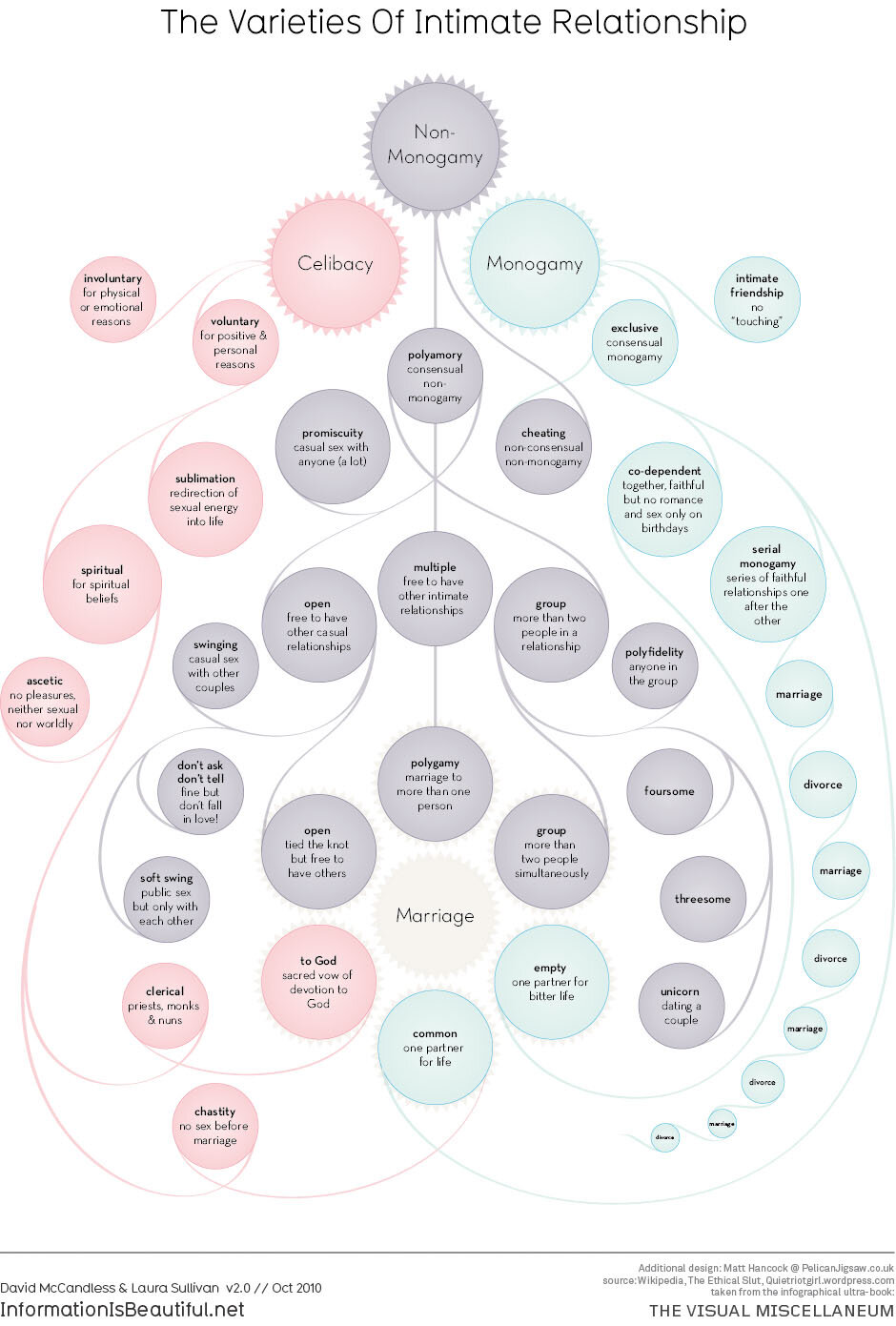
Non-monogamy is a relationship style in which a person has sexual, romantic, or emotional connections with more than one person. There are many different types of non-monogamy--swinging, open relationships, triads, polygamy, threesomes, etc. I’ve often wondered what would happen if we taught healthy relationships using a chart like this (below), to show the infinite possibilities out there and to value all types of relationships. Even if you’re super not sure about non-monogamy, there are lot of other relationship styles that we don’t often think about:
Non-monogamy isn’t new.
What might first come to mind in our country is the Mormon practice of polygyny, in which husbands would have multiple wives. But non-monogamy was also common and expected in many ancient cultures. As Dr. Michael Price of Psychology Today said: “Most ancestral men aspired to polygyny (even though most weren’t impressive enough to attract more than one wife), and some ancestral women preferred to be the co-wife of a really impressive man than the sole wife of a second-rate one.”
Theories explaining the shift to monogamy often point to the control of off-spring and resources and to Christianity. It became expected, presumed, and desirable to find your Mr. Right--your one and only for the rest of your lives. Many communities over the years fought to practice ethical non-monogamy, such as the New York Oneida community in the 1800s and the San Francisco Kerista commune in the 1960s until 1990s, yet we branded them as lustful sinners and crazy hippies. And today, we still live, dream, watch, read, and breathe monogamy. We’ve become pretty mono-normative.
What’s mono-normativity?
It’s the assumption that everyone is monogamous and wants a monogamous relationship. It’s also the fact that our systems are built for and around monogamy. This means that monogamous people have certain privileges in our society that non-monogamous folks don’t, despite the fact that an estimated half a million families in the U.S. are openly living in relationships between multiple consenting partners.
Think about it: single people, especially once they reach their late twenties, are often pestered about when they’re going to “settle down.” Marriage in the US is only legal between two people. Health insurance, taxes, and forms only cater to couples. Those of us raised on Disney princess movies dreamed of the straight, married, monogamous couple we would one day be a part of. People have lost jobs and children when the wrong folks discover their non-monogamy. This country’s institutions and social expectations are rooted in mono-normativity.
This week I stumbled across a pop culture example of mono-normativity that will hit home with the Outlander fans out there: I just finished reading a part in book six (I will purposefully be vague to avoid spoilers) in which a character is discovered to be sleeping with two twin brothers, both of whom she loves dearly. She gets pregnant from one of the brothers, and because the brothers are twins, she is unsure which one is the father. Upon her revealing the pregnancy, her father forces her to pick one brother, marries the two of them, and sends the other brother away. But the depth of their love for each other is touching: “[She] knelt on the floor, still clinging to the boys, the three heads drawn together like the lobes of a clover leaf as they murmured to one another. ‘Are you hurt?’ she was saying, and ‘Are you alright?’ they were asking, an absolute tangle of hands and arms meanwhile searching, patting, stroking, and embracing.”
Yet, evidenced in the forced marriage between only two of them to avoid scandal in their community, this triad clearly experienced the stigma of their time that non-monogamists still often experience today. A 2012 study found that many people still have negative stereotypes about people in non-monogamous relationships, believing them to be more sexually risky, less morally acceptable, and having less trusting and less meaningful relationships. The same study showed that people even thought that non-monogamists don’t floss their teeth as often or pay their taxes on time at the same rate as monogamous people, which is absolute nonsense.
In fact, researchers found that folks in ethically non-monogamous relationships are just as satisfied, committed, and passionately in love as folks in monogamous marriages. So while the stigma is real, the data show something different.
Regardless of your opinion on non-monogamy, however, knowing how to build healthy relationships is an important life skill for all of us.
And believe it or not, non-monogamists have some relationship tips that may be helpful for EVERYONE. Below are 4 tips that I hope can be useful for anyone wanting to grow and strengthen the meaningful relationships in their lives:
Communicate, communicate, communicate!
Folks engaged in ethical non-monogamy tend to be stellar communicators. Opening up a relationship requires intentional communication about boundaries, trust, hard emotions, and needs/wants. Those things are important in monogamous relationships, too! A lot of times, especially because of the state of sexuality education in this country, we’re not very practiced at having tough conversations with our romantic or sexual partners when things aren’t going exactly how we hoped or when something our partner did or said rubbed us the wrong way. We convince ourselves that maybe it’s not important enough to bring up--”I’m probably being irrational”--or we go straight towards laying blame on our partner(s) and fueling anger and bitterness. Making the time for intentional conversation with your partner(s), learning to confidently and respectfully communicate your needs and wants, and being vulnerable about your feelings with someone else can all help a relationship grow stronger and more loving.
2. Dare to feel.
Anger, grief, loss, sadness, fear… these can be really tough emotions to feel, especially when someone else caused us to feel that way. A tendency many of us have in our romantic or sexual relationships is to jump straight to the feeling of jealousy, rather than experiencing the harder emotions underneath it all. For example, am I really jealous that my boyfriend is hanging out with a good female friend or am I perhaps feeling lonely? Could my “jealousy” be alleviated if I reached out to some old friends to reconnect? Or might I feel better if we had a date night soon to celebrate us, since we haven’t had special together time in a while? Being curious about our emotions and digging into them, even the tough ones, can be really hard but also really important to maintaining healthy boundaries and contentment within relationships. Dare to feel the things. Be curious and dig deeper.
3. Rely on trust, not rules.
Any relationship, even if it’s friends with benefits or a random hook-up, requires a certain degree of trust. You have to trust that the other person is going to respect if you say “no” or “stop.” You have to trust that your emotions will be valued. You have to trust that your partner is not going to break agreements you made together.
A lot of us, even folks engaging in non-monogamy, often create a lot of rules around our relationships rather than relying on trust. Come home for family dinner or else. You’re allowed to kiss her but don’t have sex with her. You can’t talk to your ex. And the number one for monogamists: don’t cheat. What if these issues opened up a conversation rather than creating a hard and fast rule? What if the rules became questions: how can we adjust schedules so that family dinner works for all of us? Is there a reason that’s keeping you away from home so much? Why am I feeling jealous? And for the ultimate “don’t cheat” rule, what if we asked earlier enough: what’s missing for you and how can we work on that? Of course, not all relationships are healthy and can stay together. By relying on trust and conversation, you’ll find that there could be room to grow together or that you need to part ways. But either way, trust is maintained.
4. Be generous with your love.
Monogamists operate under the assumption that our love is finite. We can only love one person and for the rest of our lives. However, we know that not to be true: we love our kids. We love our family. We love our favorite barista. We love our friends. We love our favorite band. We love our communities. We know that there are so many different types of love, and the love doesn’t run out. Even if we’re stressed or sad and might be in a need of a little self love, deep down we still love others. Especially during this time when our black friends and community members are struggling against our unjust system, when our communities are being ravished by covid-19, and when our politicians are sowing hatred and fear against our fellow Americans and asylum seekers--this is the perfect time for us to realize that we must be generous with our love. Love is unbounded.
Regardless of whether you’re coupled, thrupled, or more, I hope these tips prove useful in helping promote even stronger relationships. You all deserve it.
To learn more about non-monogamy, check out the Multiamory podcast and the books Opening Up by Tristan Taormino and The Ethical Slut by Dossie Easton and Janet Hardy.

Preventing Teen Pregnancy in the Dominican Republic
In Feburary 2019, I went to the Dominican Republic with Canadian charity Rubens Shoes to launch my sexual and reproductive health program “BodyTalk”. I had a blast working with the amazing teachers of Centro Educativo Toribio and watching the kids giggle while they learn about their bodies. Read my trip report below, with lots of pictures!
In Feburary 2019, I went to the Dominican Republic with Canadian charity Rubens Shoes to launch my sexual and reproductive health program “BodyTalk”. I had a blast working with the amazing teachers of Centro Educativo Toribio and watching the kids giggle while they learn about their bodies. Read my trip report below, with lots of pictures!

Day 1 of the sexual and reproductive health teacher training in the Dominican Republic! I led a training for ten facilitators to learn to teach HIV prevention, gender equity, consent, and how to prevent sexual assault.
The Dominican Republic is a strong Catholic country. Participants pointed out that, while their personal faith encouraged them to learn and teach sexual health and education, their church is also a space where rampant sexual abuse occurs.
One participant explained that she liked the part of the training where we emphasized the fact that women and girls have power. This is so important for preventing abuse, which is rampant in the DR. Learning to communicate, understanding consent, and knowing how to find help is crucial for young people, especially girls, to feel safe and to avoid risky situations.
Another participant: “I didn’t know there was a medicine you could take to prevent HIV before actually getting it!” (It’s called PrEP—learn more) While it’s unclear whether PrEP is available in the DR, it’s still key to know that if you think you’ve been exposed, you should talk to a health professional about your options.
Through games and activities, the participants were engaged and ready to try some sample lessons on their own.

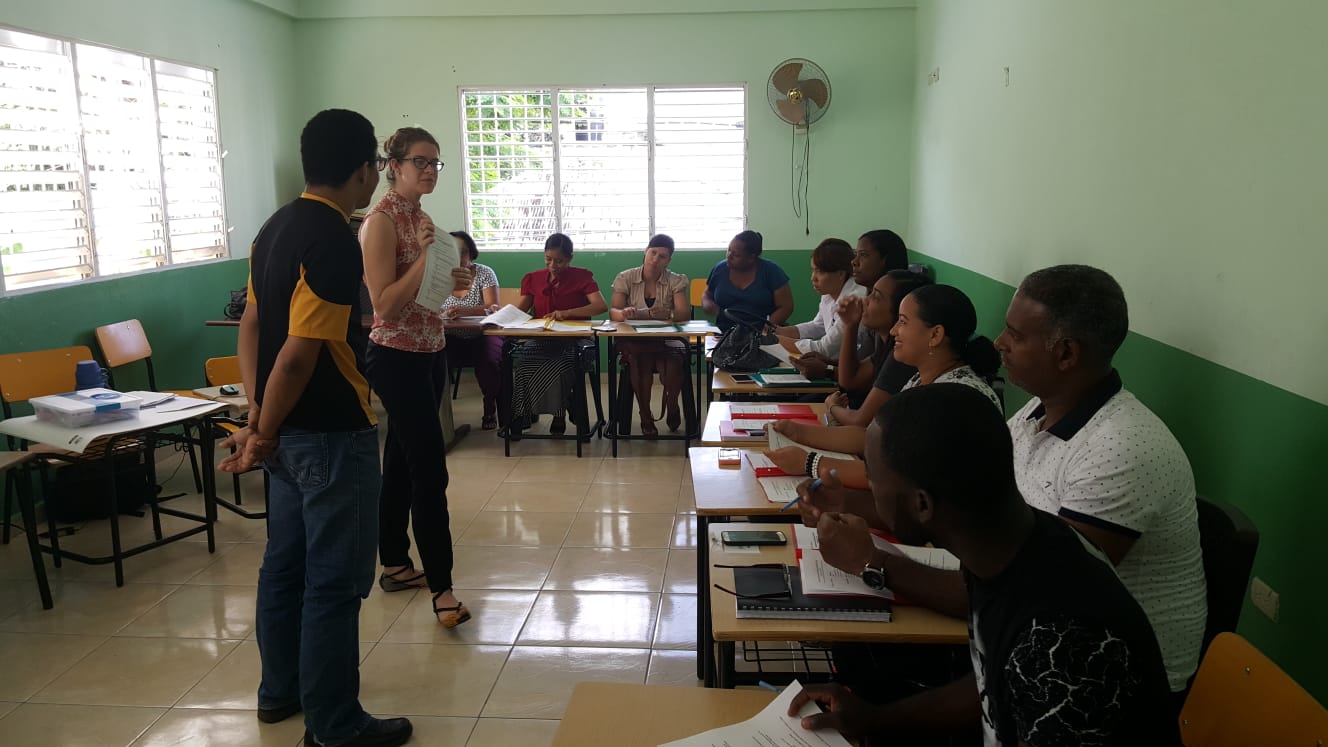


Day 2. A total of 10 teachers graduated from the program and are excited to start implementing at their school.
A brave facilitator practiced giving a condom demonstration today. A shocking number of participants, including my 22-year-old translator, had never seen a condom demonstration before. “Do all condoms really have lubricant?!” “Why is lubricant necessary?” “I never knew you were supposed to leave space at the tip of the condom!” Negotiating condom use in a country where a mere 2% of the population uses condoms is tough; learning that it’s your right to demand their use can be life changing and empowering for women.
We then discussed birth control options, some of which were familiar and some were not. Many birth control options are not available in the DR or are only available at expensive, private clinics. Demanding that restrictive governments increase access to contraception is key for women’s health and wellbeing.
One participant shared, “After the first day of training, I decided that I need to share this information with people at my church. They need to know, too. Thank you for teaching us!” Another said, “When I went home after the training, my 18-year-old niece started looking at the material and she was so interested—she couldn’t stop looking! It was good to share this information!”
We also had a meeting for the parents, to get them on board with their kids learning this invaluable information and to make sure we have permission to teach. Some parents expressed concern about “pro-sex” programs and wanted to emphasize that they teach their kids to abstain like good children should. It’s tricky explaining that with comprehensive information, kids have the ability to make better, healthier choices (which often includes delaying first sex), but by the end, the overwhelming majority wanted the program for their kids and were even asking for their older youth to participate, too.

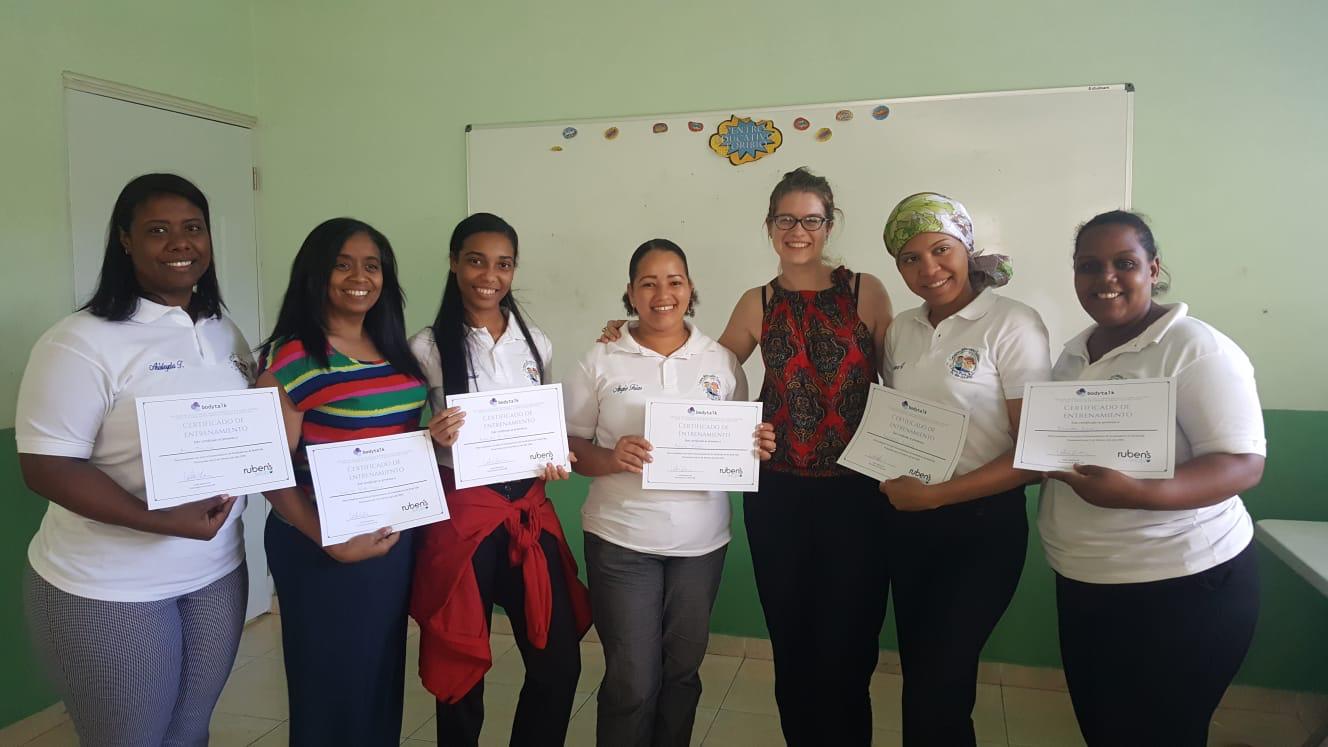

Time to convince those parents…
Day 3. We held a workshop on reproductive health topics for a group of kids ages 12-15. What began with a room full of silence and awkward teenagers turned into an empowering space for youth to discuss consent, preventing sexual abuse, goals, and gender equality.
In the workshop, the kids passed around a menstrual pad, hot potato style, with no one wanting to touch it, while normalizing periods and discussing how men and boys can support their sisters and female family members during their periods. We practiced setting long-term goals and talked about how having a child too early can affect goals like finishing school. The kids practiced asking “Can I give you a high-5? Can I give you a hug?” and discussed how asking for consent can prevent sexual assault.
The most powerful activity was hearing the kids practice saying “no”. Unfortunately, we live in a world where 35% of women will experience sexual assault in their lifetime. The kids stood in a circle and practiced touching each other on the shoulder while saying in a strong, confident voice: “Do not touch my shoulder.” Amongst the giggles, there was the start of building confidence and understanding their rights. Having that confidence and that ownership over their bodies is so important to having healthy sexual relationships.

Testing their knowledge on puberty

Practicing consent

Practicing communication skills

Writing long-term goals

Day 4. I can’t believe it’s already the last day! Despite the chaos of starting a new class, our new facilitators pulled off their first lesson on anatomy today. Twenty-two students in grades 4 and 5 were present. The boys, being 10-year-old boys, giggled and wiggled a lot and asked why their penis is so wrinkly and why the vulva is weird. The girls were so excited to learn and asked questions nonstop, putting their new teachers to the test. The program will run for 9 weeks and will continue throughout the year.
Many thanks to Rubens Shoes for their support of this program and to Centro Educativo Toribio for their awesome teachers and kiddos! #SexEdMatters y’all.

Guess that body part for the boys


Guess that body part. “How many breasts are there again…?”
