womxn • history • sex • education • social justice

Vulva vs. Vagina: What the Research Says You Need to Know
In the US, talking about our sexual anatomy is pretty darn taboo. We teach our kids to use words like “cookie”, “ding-a-ling”, and “private parts” and tend to avoid providing our kids with the specific terms like vulva, penis, and genitals.

Viva La Vulva II by Silvia de Bejar
In the US, talking about our sexual anatomy is pretty darn taboo. We teach our kids to use words like “cookie”, “ding-a-ling”, and “private parts” and tend to avoid providing our kids with the specific terms like vulva, penis, and genitals.
Our sex education is also sorely lacking, with only 17 states required to provide medically accurate information about sex and anatomy (1). Additionally, studies have found that educational textbooks fail to cover the clitoris and vulva as much as the penis or only focus on internal anatomy like the uterus, ovaries, and vaginal canal (2).
Folks think it’s inappropriate to show accurate pictures of the vulva and penis to, well, anyone--but especially kids. I wish I could count the number of times I was told as a sexuality educator that the drawing I use to show external anatomy of the vulva, clitoris, and vaginal opening was “too graphic.”
(First image: what I wish I could show students, from the Our Whole Lives curriculum. Second image: what I sometimes end up being allowed to show students.)


So it’s no surprise that as adults, we lack basic vocabulary and understanding of our sexy parts, specifically female* ones.
There’s research to prove this. A study from 2013 found that 80% of male college students and 62% of female college students were unable to locate the vagina correctly (3). 62% of female college kids can’t find the vagina?! Where do they think their period blood has been coming from?!
Another interesting study suggested that many women do not know what exactly the vulva describes and what is considered “normal” genital anatomy because they have not been exposed to a diverse range of normal genitalia (4). This is a huge issue when we’re trying to figure out what ours look like and if we should be embarrassed about them or not. (Hint: you should NEVER feel embarrassed about your sexy parts! Variety is normal!)
And there is some indication in a number of other studies that race and class may impact our knowledge of sexual anatomy, with low income individuals of color scoring lower on sexual anatomy knowledge and understanding than white individuals (5). Which is just extra bad (i.e. scary, infuriating, racist, classist, oppressive…) because everyone deserves to be represented and to know that their bodies (and their sexy parts!) are great.
So on the whole, the research points to a general lack of understanding of specifically female* genital anatomy and a confusion about what’s normal.
So let’s clear it up a bit.
One particular wisdom nugget that has been lacking in our public understanding is the difference between the vulva and the vagina.
What’s a vulva, you ask?
The word “vulva” isn’t often included in our anatomy lessons even though it’s pretty much THE term to describe the private parts of about half of the world’s population.
The vulva describes the area containing the labia, clitoris, vaginal opening, and urethra. The vagina is the canal that is mostly on the inside of the body and that connects the vaginal opening to the uterus. The vaginal opening is the only part of the vagina we see from the outside.

The vulva is the whole bit, the vagina is the internal canal leading to the uterus. We can only see the vaginal opening from the outside. (Source: Lady Suite)
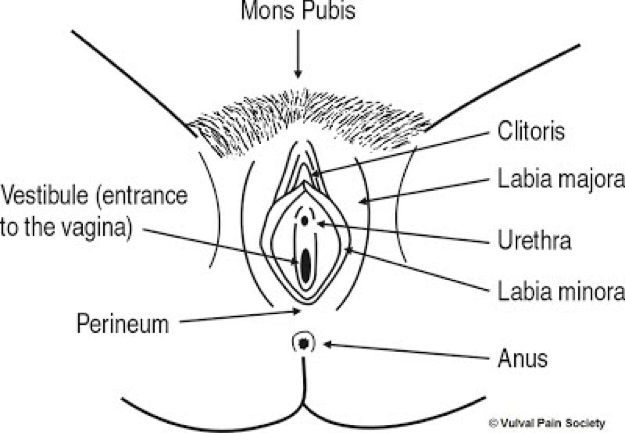
To brush up on your general sexual anatomy knowledge, check out this great resource page from Planned Parenthood: https://www.plannedparenthood.org/learn/health-and-wellness/sexual-and-reproductive-anatomy/what-are-parts-female-sexual-anatomy (Source: Vulval Pain Society)
The TV show Big Mouth does a great job explaining the difference and walking you through the different parts of the vulva, with a cute vulva friend as your guide:

The other aspect that is sorely lacking is diversity of vulvas. Because of anatomy textbooks and porn, we imagine all vulvas are white and smooth, with pink lips, no hair, and tiny labia. Not true! Vulvas come in so many shapes, sizes, and colors and it’s a sad thing that we don’t get to see that variety until we’re actually having sexy time with others. It causes folks to think their vulvas are abnormal, smelly, embarrassing… when in reality, they are totally great just how they are!
So I leave you with a great big variety of truly lovely vulvas.
And if you haven’t already, go ahead, take a mirror, and do a little exploring yourself. Or treat your vulva-owning partner to a little tour, with their consent of course.


Image 1: #VULVALUTION by Cult Beauty
Image 2: The Vulva Gallery by Hilde Atalanta
Image 3: Vula art by Vielma.at
Image 4: Vulva art by Vielma.at
Image 5: The Great Wall of Vagina (although it should be called ‘The Great Wall of Vulvas’....) by artist Jamie McCartney
Image 6: By Erin Tobey
End Notes:
*female: I use the term “female” because the research uses this term to describe folks with vulvas, uteruses, and ovaries. However, some folks with vulvas don’t identify as women, and some women don’t have vulvas.
References:
Guttmacher Institute. (2020, October 12). Sex and HIV education. Guttmacher Institute. https://www.guttmacher.org/state-policy/explore/sex-and-hiv-education
O’Connell, H. E., Sanjeevan, K. V., & Hutson, J. M. (2005). Anatomy of the clitoris. The Journal of Urology, 174, 1189 –1195; Ogletree, S. M., & Ginsburg, H. J. (2000). Kept under the hood: Neglect of the clitoris in common vernacular. Sex Roles, 43(11/12), 917-926; Orenstein, 2015, cited in Hesse, C. & Pedersen, C. L. (2017). Porn sex versus real sex: How sexually explicit material shapes our understanding of sexual anatomy, physiology, and behaviour. Sexuality & Culture, 21, 754–775.
Volck, W., Ventress, Z. A., Herbenick, D., Adams Hillard, P. J., & Huppert, J. S. (2013). Gynecologic knowledge is low in college men and women. Journal of Pediatric & Adolescent Gynecology, 26(3), 161-166.
Howarth, C., Hayes, J., Simonisa, M., & Temple-Smith, M. (2016). ‘Everything’s neatly tucked away’: Young women’s views on desirable vulval anatomy. Culture, Health & Sexuality, 18(12), 1363–1378.
Angulo-Olaiz, F., Goldfarb, E. S., & Constantine, N. A. (2014). Sexuality information needs of Latino and African American ninth graders: A content analysis of anonymous questions. American Journal of Sexuality Education, 9, 21-40; Cooper, S. C., & Koch, P. B. (2007). “Nobody told me nothin”: Communication about menstruation among low-income African-American women. Women & Health, 46, 57– 78; O’Sullivan, L. F., Meyer-Bahlburg, H. F. L., & Watkins, B. X. (2001). Mother-daughter communication about sex among urban African American and Latino families. Journal of Adolescent Research, 16(3), 269-292; White, L. R. (2013). The function of ethnicity, income level, and menstrual taboos in postmenarcheal adolescents’ understanding of menarche and menstruation. Sex Roles, 68(1–2), 65–76.

The Science of Blue Balls
The topic of blue balls has recently come up for me in conversations—you know, as just a thing young adults talk about. What is it? Does it actually exist? What does the medical world say about it? Is it “real”? As a sex educator, of course I wanted to dig deeper and find out more.
The topic of blue balls has recently come up for me in conversations—you know, as just a thing young adults talk about. What is it? Does it actually exist? What does the medical world say about it? Is it “real”? As a sex educator, of course I wanted to dig deeper and find out more.
For those who aren’t familiar with the term, “blue balls” refers to the phenomenon in which a person’s testicles allegedly turn blue because of unreleased pressure during sexual arousal. Basically, during arousal, blood flows to the penis to allow it to become hard, or erect, and sperm readies itself to exit the penis through ejaculation. The idea is that when the sperm are not released through ejaculation, it creates an aching, painful sensation or pressure that has been termed “blue balls.” In other words, it’s the pain and discomfort caused from not getting off.
Before I dove into medical research on the subject, I wanted to explore the language we use to describe blue balls. I googled “blue balls” and perused the top hits.
From an article on dudeproducts.com, we get language such as this:
“But seriously, blue balls is totally a thing—and it can be agonizing. So, what exactly is this scrotal suffering? How does it happen? Is there hope for the afflicted?”
An article on askmen.com adds:
“The more easily you're aroused, the more likely you'll suffer the wrath of blue balls.”
A Men’s Health article states, “For centuries, men have bemoaned the scourge of blue balls.”
Urban dictionary describes blue balls as “a ridiculously painful condition” and one user wrote, “It felt so brutal. I held my balls in pain but it was like they were replaced by sad blue bags of disappointment.”
“Sad blue bags of disappointment”?? For real?
What does this language suggest?
It paints the condition of blue balls to be one of agonizing pain and suffering. It insinuates that this suffering should be avoided at all costs—why would anyone want to feel that amount of pain and discomfort? It touches on the “disappointment” men feel when they’re not given the orgasm they expect. It calls upon the traditional gender norms that women should please their men and that men should not have to suffer any denial of sexual pleasure.
Indeed, it was presumed by myself and my female peers growing up that blue balls was a condition to be avoided at all costs and one that women were expected to prevent and alleviate during sexual interactions. The blue balls excuse was used both externally by male partners pressuring women to finish them off and internally by women feeling they needed to follow sexual acts to completion for their male partners in order to avoid hurting them.
The excuse of blue balls has been used to perpetuate the patriarchal “norms” that privilege male pleasure and sexual experience over anyone else’s.
But are blue balls real? Or has the condition been made up and/or exaggerated to support the patriarchy?
I turned to medical literature.
I did some basic google searches and found that blue balls has also been called epididymal hypertension or vasocongestion, or I even found it being called DBS, or deadly sperm buildup. So, besides the last one, these terms made it seem like it could be a “legit” medical condition.
Yet, even using those search terms, I found little to no information in the (albeit limited) medical journals I have access to on the concept of blue balls. I even reached out to my mother, a family physician, and my graduate school professor, a pediatrician who teaches our Reproductive Biology class, and they couldn’t find any additional literature either.
My searches only came up with one article in Pediatrics and two associated Letters to the Editor commenting on that article.
The original article, published in Pediatrics in 2000, detailed a 14-year-old male who showed up at the ER with 1.5 hours of prolonged scrotal pain. After an hour of observation, the pain receded and he left the ER. The article detailed that “Telephone follow-up several weeks later revealed that the patient had begun to have sexual intercourse with his girlfriend, and no further episodes of testiculoscrotal pain had occurred.”
Of course, I couldn’t help but wonder if the patient used his pain as an excuse to get his girlfriend to have sex with him…. But, who knows.
The rest of the one-page article described the complete lack of any reference to blue balls in medical literature as of 2000 and physicians’ lack of medical understanding of the phenomenon. It then went on to suggest that the treatment was sexual release or perhaps lifting something heavy like a car bumper. (LOL—what??)
The letters to the editor, also from 2000, disputed the treatment option of lifting car bumpers as the first choice when masturbation is such a clear solution (thank you). Yet, another letter expressed concern of unilaterally advocating for such a controversial solution like masturbation, claiming the adverse effect of blindness. (The only source of this was “personal communication” from “our mothers” so….)
When I reached out to my professor regarding this lack of literature, he reminded me of the danger of using only the medical establishment to confirm or reject possible real-life experiences. I had definitely heard stories from male friends of their very real experiences of blue ball pain—why would they make that up?
I was reminded of the history of the medical field—doctors and researchers alike—discounting the very real pain of black folks in particular: for example, the incredibly painful experiments without anesthesia on female slaves by the doctor heralded as the man who devised effective treatment for vesicovaginal fistulas. Or the experiments conducted on black prisoners by the world-famous dermatologist that left them with painful sores and lifelong medical complications. I’ve heard stories even today of black women being denied pain relief when they turn to medical professionals for help. There is a history of Western medicine discounting folks’ pain that deserves attention.
And also, I think about how the experience of blue balls has been used by privileged men, not just wealthy, white men but by men generally who inherently have privilege through their gender, to coerce and force women (probably womyn* too, I’m just less familiar) into having various forms of sex against their will.
Regardless of the discomfort in someone’s genitals, no one should ever feel they need to have sex to relieve someone’s pain.
So, here’s what I can leave you with:
1) No medical research can confirm that the testicles actually turn blue from a lack of sexual release—that piece might be a myth. If they are turning blue, it could be indicative of a more serious problem, like testicular torsion, that requires immediate medical attention.
2) It was also pretty clear in my search that the condition is not a dangerous one. There is no risk of rupture, permanent damage, or death (of sperm or patient).
3) Masturbation is great. Jerk off, yank one out, beat the bishop…. Masturbation is a safe, risk free way to embrace pleasure and release sexual tension (regardless of anatomy!). It will not make you blind or cause your hands to get hairy, despite what those doctors’ moms say.
4) Folks with vulvas get sexually frustrated, too! I kept thinking in my research, why aren’t blue vulvas being talked about?? How many times have I had to suffer the “excruciating pain” of my male partner getting off while leaving me with not even an inkling of attention for my lady parts? Male pleasure is expected and prioritized; female pleasure is ignored and devalued.
5) And the key message I hope you all leave with: no one should ever feel coerced, pressured, or forced to have any kind of sex they don’t want. Blue balls, or literally anything else, should not be a reason to finish someone off. Everyone is responsible for their own pleasure—as Men’s Health says, “go be a man” [or a woman, or a person!] “…and take care of yourself.”
*womyn: Many folks identify as women but don’t have vulvas or uteruses. The spelling of women as “womyn” accounts for the fact that womynhood can be defined in so many ways and all are great.